Folio 171b
…God Most High knows.
The creatures that live in water are very many. But what is well known is this: the animals that live in water are of two kinds. One kind has no lung, like the fish; what has no lung cannot live anywhere but in the sea. The other kind has a lung; it draws moisture from between water and air, and lives both in water and on land.
One of them is the arnab al-ma', that is, the water-rabbit: its head resembles a rabbit's head and its body is like a fish. The Shaykh al-Ra'is (Avicenna) says: the water-rabbit is a shelled animal and tends to red; on its limbs there are things resembling ushnan (saltwort) and its fineness(?). It removes bahaq (white patches on the skin). If its head is burnt and smeared on a place where hair does not grow, it makes hair grow. And this is its picture.*1
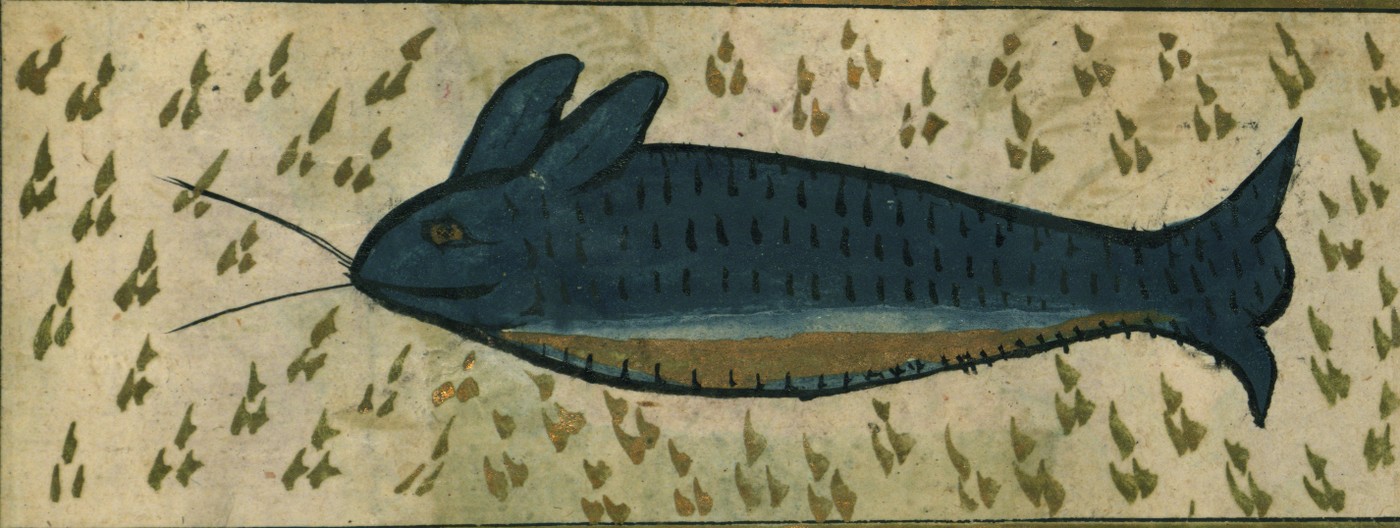
The Elyes(?) is a fish, a fearsome kind. Every animal can be caught, but this one cannot be caught. Its food is the bones(?) of animals. Its properties: if its flesh is cooked and fed to two people who are enemies of each other, they grow fond of one another and love each other and never part.*2*3
The insan al-ma', that is, the water-man: its form resembles a human's, but it has a tail. It is told that in the Sea of Syria it comes out onto the shore and stays out of the water for several days; they call it Shaykh al-Bahr (the Old Man of the Sea). Whenever people see it out of the sea they take it as a blessing and give one another the good news, for it is a sign of plenty: by God's command all food becomes abundant, and fruit too becomes abundant.
It is related that they brought to Khosrow a human-like(?) [?]. The king wished to learn what its nature was…*4*5
continues on fol. 172a…However hard they tried, nothing could be understood of…* Needs human approval · 5
- *1line 7
اشنان و دقتهother readings:اشنان دقیقه (ezilmiş üşnan),اشنان و دقته (üşnan ve inceliği)Harfler açık: اشنان, ayrı bir و, دقته. 'Uzuvlarında üşnan ve inceliğine benzer şeyler olur' cümlesi tuhaf; Arapça asılda belki 'ezilmiş üşnan gibi' (کالاشنان المدقوق) bir ifade var. Kazvînî/İbn Sînâ'nın erneb-i bahrî maddesiyle karşılaştırılmalı. - *2line 9
الیسother readings:إلیاس (İlyâs),الیس (Elyes),اللیثKırmızı başlık harfleri açık okunuyor: ا ل ی س (ی'nin altında iki nokta). Kazvînî'nin deniz hayvanları listesinde hangi ada karşılık geldiği bilinmiyor; prose'da Elyes(?) bırakıldı. - *3line 10
کموکیدرother readings:کمکیدر (kemiğidir),کمرکیدرHarfler ک م و ک ی د ر gibi; 'gıdası hayvanların kemüğidir' (kemiğidir) okundu, ama 'avlanamayan korkunç balığın gıdası kemik' bilgisi Arapça asılla doğrulanmalı. - *4line 17
ماندother readings:مانند (mânend, benzer),ماندن (mâdan)Kelime م ا ن (noktalı) + د'ye benzer harf (üstünde nokta) olarak görünüyor; ikinci ن dişi görünmüyor. 'insân-mânend' (insana benzer) okundu; 'insân-ı mâdan' (su insanından) da bağlama uyar. - *5line 17
بنحیّاother readings:بر … حیّاً (bir … diri olarak),بچه (beççe, yavru)Harf iskeleti: ب (alt nokta), ن (üst nokta), ح/ج, ی (iki alt nokta, üstünde şedde), ا. Sondaki 'حیّا' Arapça 'hayyen' (diri olarak) olabilir; önündeki 'بن' çözülemedi. Prose'da [?] bırakıldı.
Resolved or approved · 6
- resolvedline 2
دیهسیother readings:رئهسی (ri'esi, akciğeri)ÇÖZÜLDÜ: ر=د alışkanlığı. Kazvînî suda yaşayanları akciğeri olan ve olmayan diye ikiye ayırır; 'balık gibi… denizden başka yerde yaşayamaz' ve 'su ile hava arasından nem alır, suda ve karada yaşar' cümleleri ri'e (akciğer) okumasını kesinleştiriyor. L3 دیهسی ve L4 دیهدر aynı kelime. - resolvedline 6
شیخ دئیس ایدر ادنب ماءother readings:شیخ رئیس ایدر ارنب ماءÇÖZÜLDÜ: ر=د alışkanlığı; Şeyh-i Reis (İbn Sînâ) Kazvînî'nin tıbbî hassalarda sık andığı kaynak, 'ارنب ماء' L5'teki kırmızı başlığı tekrarlıyor. - resolvedline 11
اوزده … یدردلسهother readings:اوزره … یدیرلسهÇÖZÜLDÜ: ر=د alışkanlığı; 'adâvet üzre olan iki kimesneye yedirilse' bağlamı açık. - resolvedline 12
بسother readings:پس (pes)ÇÖZÜLDÜ: tek alt noktalı ب + س; Farsça 'pes' (imdi, öyleyse) bağlacı, L13 'مذکوددکه' ile cümle kuruyor. - resolvedline 14
شیخ البحدother readings:شیخ البحرÇÖZÜLDÜ: ر=د alışkanlığı; Şeyhü'l-bahr (Deniz Şeyhi), su adamının bilinen adı. - resolvedline 17
کتوددیلر … نددother readings:کتوردیلر … ندرÇÖZÜLDÜ: ر=د alışkanlığı; 'getürdiler', 'nedür'.